Many systems appear stable until suddenly they are not.
Climate tipping points, market crashes, ecological collapse, infrastructure failures, and chaotic physical systems often share a common characteristic: long periods of apparent stability followed by rapid transition.
My research explores how these transitions emerge, how they can be detected, and how mathematical tools can help us better understand uncertainty in complex environments.
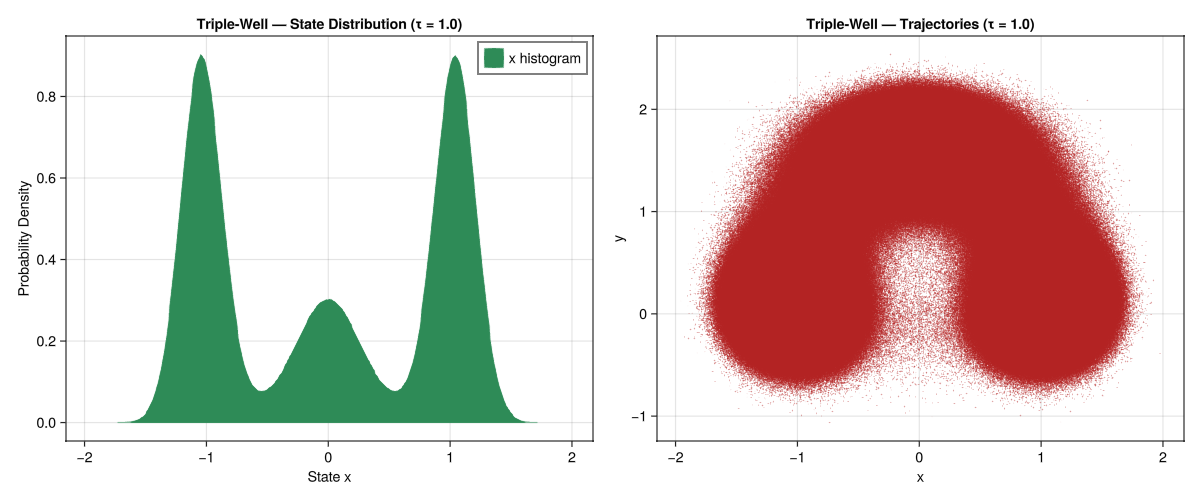
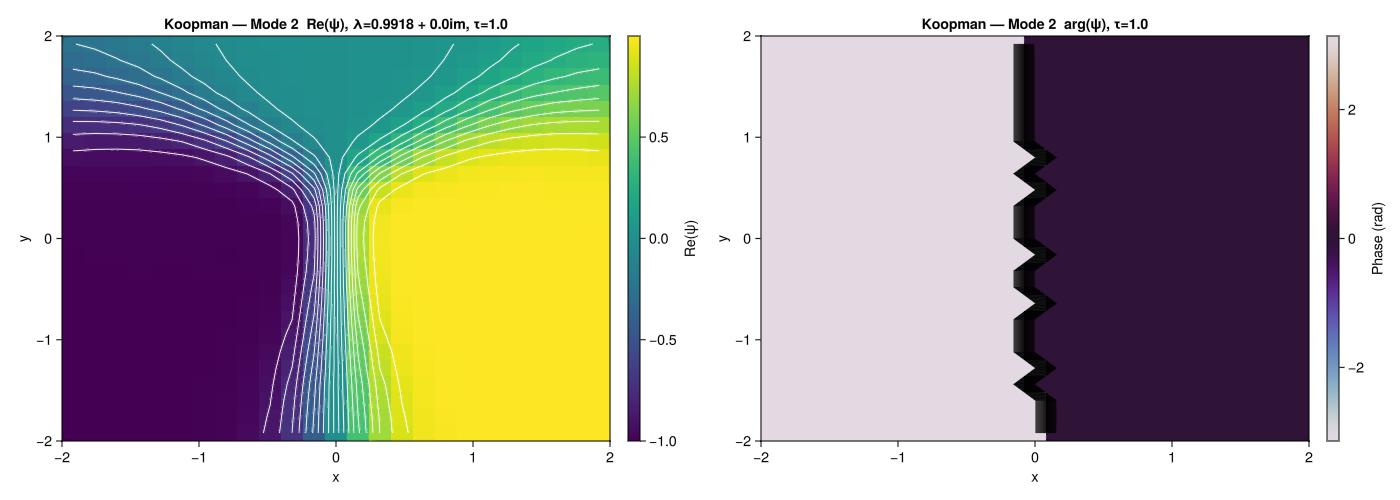
My current doctoral research investigates metastable systems and critical transitions through operator-theoretic approaches to stochastic dynamical systems.
Using Koopman and Perron-Frobenius operators, I study how systems transition between long-lived states and how those transitions can be detected before they occur.
The work combines stochastic differential equations, statistical physics, transfer operator theory, spectral analysis, and large-scale computational simulation.
University of Leicester | 2025 – Present
How can metastable states be identified?
What pathways emerge during critical transitions?
How do heavy-tailed shocks alter system behaviour?
Can early-warning signals be extracted before tipping points occur?
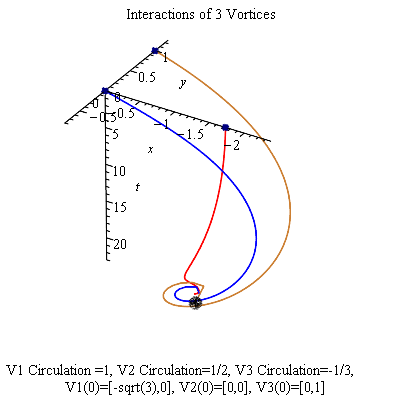
My dissertation explored collapse phenomena in interacting vortex systems.
Beginning with theoretical mathematical derivations, I built a simulation framework capable of modelling complex vortex interactions and identifying the conditions under which stable structures break down.
The project ultimately became an investigation into sudden transitions and instability, themes that continue throughout my current research.
University of Dundee | 2020 – 2021
Nonlinear dynamical systems
Numerical simulation
PDE generation frameworks
Chaotic behaviour
Collapse detection
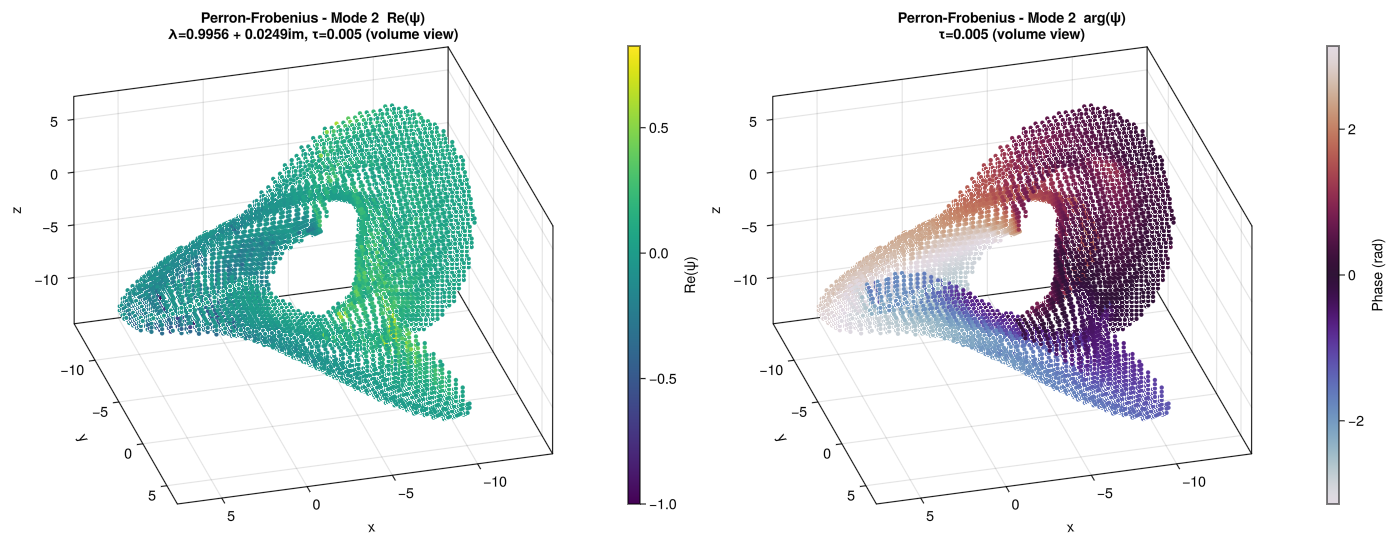
Using operator-theoretic methods, I analysed classical chaotic systems including the Halvorsen and Rössler attractors.
The objective was to reveal coherent transport structures and hidden long-term behaviour that are difficult to observe through trajectory analysis alone.
This work demonstrated how complex systems can often be understood more effectively through the evolution of observables rather than individual state variables.